
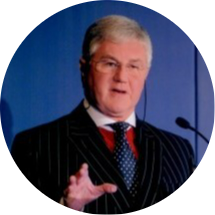
PROFESSOR JOHN MARSHALL
MBE, BSc (Hons), PhD, FMedSci, FRCPath, FRSB, CSci,
DSc(Hon Glasgow Caledonian) DSc(Hon London Metropolitan)
FRCOphth (Hon), FCOptom (Hon), FARVO, FAcadTM, FLIA, FRSA
Professor John Marshall is best known for inventing and patenting the revolutionary Excimer laser for the correction of refractive disorders with in excess of 90 million laser based procedures now having been undertaken worldwide. For this innovation he has been recognised by colleagues throughout the world and by honours and awards from professional institutions. He cofounded the first company to receive FDA approval for laser refractive surgery. He also created the world’s first Diode laser for treating eye problems of diabetes, glaucoma and ageing. His lifelong studies of the ageing retina have led to the development and patenting of a revolutionary new laser, 2RT, which is proving successful in the treatment of dry AMD. He has however kept a very low media profile.
Professor John Marshall was the Frost Professor of Ophthalmology and Director responsible for Enterprise and Innovation at the Institute of Ophthalmology, University College, London in association with Moorfields Eye Hospital. He now holds Emeritus Professorships of Ophthalmology at both Kings College London and University College, London,. He has been Honorary Distinguished Professor University of Cardiff, Honorary Professor the City University and Honorary Professor Glasgow Caledonian University. His research over the past 60 years has ranged over a number of ocular problems but has concentrated on the development of lasers for use in ophthalmic diagnosis and surgery, the inter-relationships between light and ageing, together with the environmental mechanisms underlying age-related, diabetic and inherited retinal diseases. This work has resulted in over five hundred research papers, 44 book chapters and 7 books.
He is editor and co-editor of numerous international journals. He has successfully trained over 60 students for higher doctorates. He has given 62 eponymous lectures and has received numerous awards together with 28 prestigious medals including the Nettleship Medal of the Ophthalmological Society of the United Kingdom, the Mackenzie Medal, the Raynor Medal, the Ridley Medal, the Ashton Medal, the Ida Mann Medal, the Lord Crook Gold Medal of the Worshipful Company of Spectacle Makers, the Doyne Medal of the Oxford Congress, the Peter Watson Medal of the Cambridge Symposium, the Barraquer Medal of the International Society of Cataract and Refractive Surgery, the Kelman Innovator Award and Medal of the American Society for Refractive and Cataract Surgery, the Lim Medal of the Singapore National Eye Centre and the Junius-Kuhnt Award and Medal for his work on AMD. In 2014 he was honoured with the Zivojnovic Award by the European Vitreo Retinal Society, a Lifetime Achievement Award by the UK & Irish Society for Cataract & Refractive Surgery, delivered the Bowman Lecture and received the Bowman Medal. He received the Fankhauser medal from the Swiss Ophthalmological Society in 2024, and more recently the Charles McGee medal from the British Society for Refractive Surgery in 2026 . He has been consistently voted onto the Ophthalmologist Power List of the most influential people in the world of Ophthalmology, and was the only scientist. He has been visiting professor at numerous universities on every continent.
He has more than 65 patents and has held posts chairing the medical advisory boards of many international companies and was a founder director of Diomed for some years, this being the leading supplier of diode laser systems for general surgery. He is a director of AlphaRet and executive chairman and director of PNDS, a company diagnosing prostate cancer from male urine.
He has sat on and chaired many national and international committees* concerned with protecting the public against the possible damaging effects of lasers and other artificial light sources. John played the leading role with the International Committee of the Red Cross , chairing a scientific review board and addressing the United Nations to obtain a Geneva Convention banning the use of anti-personnel laser weapons.
He was the Chairman of the Medical and Scientific Advisory Board of the British Retinitis Pigmentosa Society 1973-2011 and remains a founder Trustee, until 1995 he was Co-Chairman of the Medical and Scientific Advisory Board of the International Retinitis Pigmentosa Association. He was a scientific adviser and is a Vice President of the then National Eye Research Centre and is one of two Ambassadors of Fight for Sight. He is a trustee of the Frost Foundation, giving career development awards to young ophthalmologists, was a scientific adviser to Blind Veterans UK and is a member of the executive committee of Commonwealth Futures looking to harmonise eye care in the Commonwealth.
He is a Fellow of the Royal College of Pathologists, a Fellow of the Association for Research in Vision and Ophthalmology and has been elected a Fellow of the Academy of Medical Sciences and a Fellow of the Royal Society of Biology. He is also an Honorary Fellow of the Royal College of Ophthalmologists, an Honorary Fellow of the College of Optometrists, a Fellow and past Director of the Laser Institute of America, a Fellow of the Royal Society of Arts and an Honorary Fellow of Cardiff University.
He has a Senior Achievement Award of the American Academy of Ophthalmology and the Euretina Award of the European Society of Retinal Surgeons. In 2009 he was honoured with a Lifetime Achievement Award by the International Society of Cataract and Refractive Surgeons and the American Academy of Ophthalmologists. He is a Fellow of ophthalmological societies of several different countries, as well as being elected to the European Academy of Ophthalmology. During 2011-2012 he was the Master of the Worshipful Company of Spectacle Makers. In 2013 he was awarded the MBE in the New Year Honours List for services to Ophthalmology and an honorary DSc from Glasgow Caledonian University. In 2015 he was awarded an honorary DSc by the London Metropolitan University and elected Chartered Scientist by the Royal Society of Biology in 2017. He was appointed Honorary President of the International Society of High Technology in Ophthalmology in 2018. In 2019 he was awarded the Laser Ambassador Award of the Association of Industrial Laser Users for his work in promulgating lasers to the general public and was elected a Fellow of the European Academy of Translational Medicine Professionals. He delivered the 2019 Dame Ida Mann lecture to the Royal Australian and New Zealand College of Ophthalmologists. In 2023, he delivered the Joseph Colin Award Lecture to the American-European Congress of Ophthalmic Surgery, the 2023 DOC lecture at the 35th International Congress of German Ophthalmic Surgeons, the Dr K Bhujang Shetty Oration lecture and the inaugural Ridley Award Lecture of the United Kingdom and Ireland Society of Cataract and Refractive Surgeons.
He continues to play a very active role in industry having served on the board of Avellino, a genetic diagnostic company, and as the chairman of their Executive Scientific Advisory Committee. He is a director of AlphaRet, the company building and distributing the 2RT Laser for AMD, which is currently undergoing multicentre clinical trials. In the world of start-ups he is director of scientific affairs of Xenia a company using pig corneal tissue to treat Keratoconus and refractive problems, and was senior scientific consultant to Toku Eyes concerning the role of AI, and to Excelsius in developing novel refractive lasers. He also consults for a number of the major international companies in the field of ophthalmology. He was very much involved in the development of cross-linking, particularly with Down’s syndrome children and is now working to establish safety criteria in the red light treatment of myopic children.
* World Health Organisation (WHO), United Nations European Programme (UNEP), Non-ionizing Radiation Committee of the International Radiological Protection Association, International Electro-Technical Commission (IEC), British Standards Institution (BSI), European Community (EC), International Committee of the Red Cross (ICRC), National Radiological Protection Board (NRPB).